
Introduction
After more than a decade of global cloud adoption, one pattern is clear:
👉 Nearly 80% of cloud incidents come from the same recurring mistakes.
Cloud computing has become the backbone of digital transformation. It enables speed, scalability, resilience — and paradoxically, a much larger attack surface.
Contrary to a common misconception, the cloud itself is not inherently insecure. What creates vulnerabilities are misconfigurations, weak access controls, and the absence of proper governance.
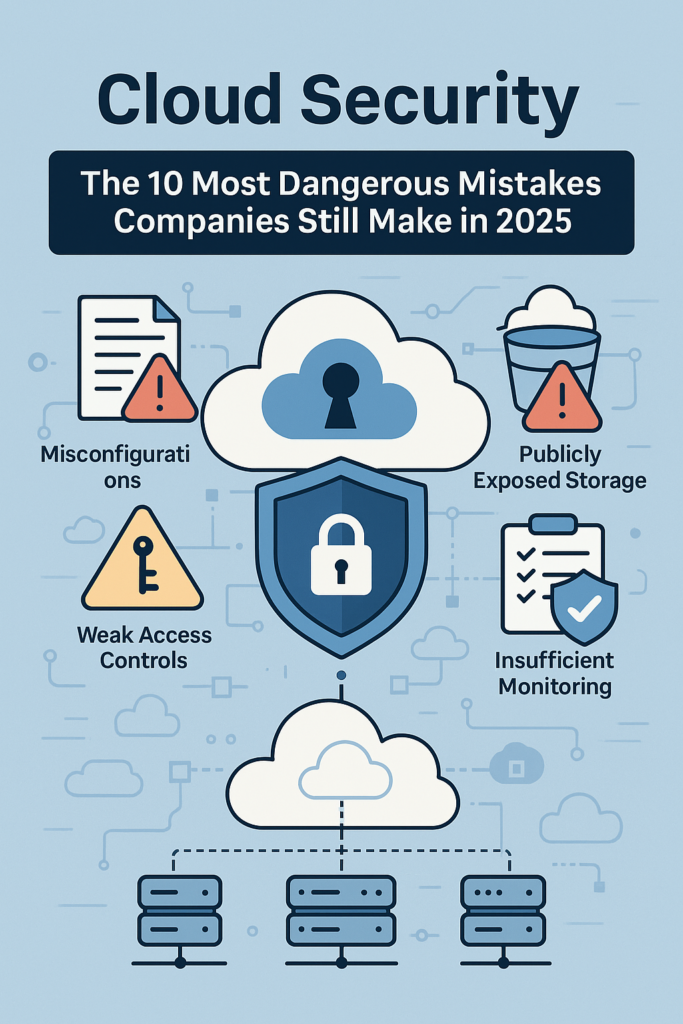
Here are the 10 most dangerous cloud security errors companies still make in 2025 — and how to avoid them.
1. Believing that “security is included” in the cloud
This is by far the most common misconception.
Cloud providers secure their infrastructure, but it is up to you to secure:
- identities and access
- configurations
- data
- workloads
- network exposure
This is the foundation of the Shared Responsibility Model, which many organizations misunderstand.
Reality: The cloud doesn’t remove responsibility — it redefines it.
2. Weak identity and access management (IAM)
Almost every major cloud breach begins with poor access hygiene:
- Overprivileged accounts
- Missing MFA
- API keys that never expire
- Excessive use of root/global admin accounts
- Permanent privileged access
An attacker doesn’t need a zero-day exploit.
A forgotten API key in a Git repo is enough to compromise an entire environment.
Essential best practices:
- Enforce MFA everywhere
- Apply least-privilege access
- Rotate keys automatically
- Use temporary elevated access (Just-In-Time)
- Monitor IAM activity continuously
3. Exposing cloud storage to the public internet
Misconfigured S3 buckets, Blob storage, or object stores remain one of the most common data leakage vectors.
This is not a technical flaw — it’s human error.
A public bucket can unintentionally expose:
- customer data
- internal documents
- backups
- credentials
- system reports
How to avoid this:
- Block public access by default
- Use predefined secure policies
- Run automated configuration scans
- Encrypt all data (even non-sensitive)
4. Not encrypting data by default
In 2025, there is no valid reason to operate unencrypted data:
- at rest (databases, object storage, VMs)
- in transit (TLS everywhere)
- in use (confidential computing, where appropriate)
Cloud providers offer native encryption with no operational overhead.
If data is leaked unencrypted → it’s a crisis.
If data is leaked but encrypted → it’s noise.
Encryption drastically reduces the blast radius of any incident.
5. Lack of visibility and logging
A cloud incident without logs is:
- impossible to analyze
- impossible to contain
- impossible to prove for cyber insurance
- impossible to report to regulators
Yet many organizations fail to activate:
- access logs
- network flow logs
- IAM audit logs
- configuration change logs
Recommendation:
Enable centralized logging from day one, integrated with a SIEM or native monitoring solution.
6. Poor network segmentation
Many cloud architectures remain flat, allowing unnecessary lateral movement.
This gives attackers a free playground.
Modern segmentation should use:
- separate VPCs/VNETs
- dedicated subnets
- private endpoints
- cloud-native firewalls
- Zero Trust network principles
Goal: limit propagation, even if one component is compromised.
7. Misconfigured workloads (VMs, containers, Kubernetes)
Workloads are often deployed quickly, inconsistently, and without security guardrails.
Typical issues include:
- open ports
- unverified container images
- overly permissive permissions
- weak Kubernetes RBAC
- lack of vulnerability scanning
Solution approach:
- Apply CIS Benchmarks
- Use a CSPM (Cloud Security Posture Management) tool
- Enforce signed and trusted images
- Implement Kubernetes network policies and RBAC hardening
8. Assuming “the cloud = backup”
One of the most costly misconceptions.
Cloud storage is not a backup strategy.
Ransomware, accidental deletions, configuration errors — everything can be lost if backups are not properly managed.
Best practices:
- Follow the 3-2-1 rule
- Use immutable backups
- Test restorations regularly
- Store backups outside the main tenant/subscription
9. Shadow IT and unmanaged SaaS sprawl
A silent but rapidly growing risk.
Teams frequently use:
- unapproved SaaS tools
- free online services
- browser extensions
- public AI tools
Each of these can extract, store, or process sensitive data outside your control.
Key mitigations:
- Maintain a SaaS inventory
- Use a CASB to detect shadow tools
- Define a clear SaaS approval process
- Educate employees on data handling risks
10. No cloud-specific incident response plan
Many companies have a traditional IT response plan but nothing tailored to cloud incidents.
Cloud incidents require:
- rapid token revocation
- configuration rollback
- IAM threat investigation
- coordination with the cloud provider
- predefined remediation steps
- automated contain/restore actions
Without a cloud-adapted playbook, even a minor issue becomes chaos.
Conclusion: Cloud security is not a project — it’s an ongoing discipline
Cloud adoption brings huge value but introduces new responsibilities.
The organizations that succeed are those that adopt:
- strong governance,
- controlled and monitored configurations,
- mature identity management,
- proactive monitoring and logging,
- a “secure-by-default” engineering culture.
The good news?
👉 Avoiding the 10 mistakes above eliminates most cloud risks before they become incidents.
Strengthen Your Cloud Security Posture with Xeno IT
Xeno IT helps organizations build secure, resilient cloud environments through:
- Cloud security posture assessments
- Architecture reviews (AWS, Azure, GCP)
- Identity & access hardening
- SaaS governance and cost control
- Cloud compliance & best-practice frameworks
- Cloud incident response planning
Want to evaluate your cloud security posture?
Contact us for a tailored assessment. Contact